Andrea Cramer
Price testing is the practice of trying different prices in a controlled way to learn how they affect demand, conversion, and profit — so you set prices on evidence instead of a hunch. Done right, it lets you find a better price without alienating the customers you already have. After fifteen years pricing products in ecommerce, I’ve never seen a pricing decision improved by less data; price testing is how you get that data safely.
This guide covers what price testing is, why it matters, the main methods, how to run an A/B price test, testing for subscriptions, and the mistakes to avoid.
What you’ll find in this guide
- What is price testing?
- Why price testing matters
- Price testing methods
- How to run an A/B price test
- Price testing for subscriptions
- Common price testing mistakes
- Frequently asked questions
What is price testing?
Price testing is the process of assessing how different price levels affect consumer behaviour and sales, so you can choose the price that best meets your goals. Instead of guessing whether $19 or $24 works better, you measure it — comparing conversion, revenue, and margin at each price. It’s a structured way to keep pace with a market that keeps moving: new competitors, shifting costs, and changing demand all move the “right” price over time.
Why price testing matters
Price is the fastest lever on profit, and it’s the one most businesses set once and forget. Testing matters because it lets you adapt as the landscape shifts — a new competitor undercutting you, a jump in material costs, a change in demand — and because the upside is asymmetric: a small, validated price improvement flows almost entirely to the bottom line. It also protects you from the opposite risk, changing a price on instinct and quietly losing volume you never realise you gave up.
Price testing methods
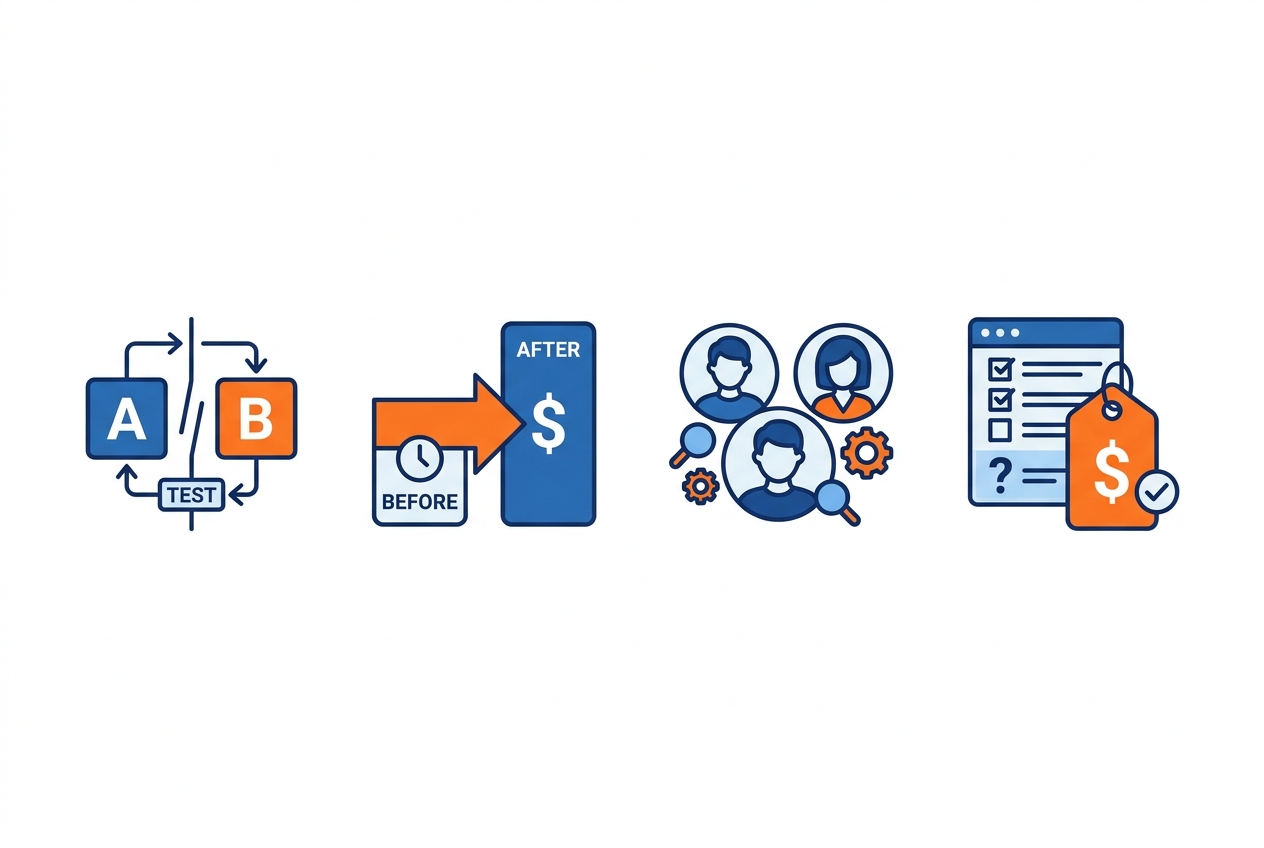
There’s more than one way to test a price. The right method depends on your traffic, your catalogue, and how much risk you can take with live customers.
How to run an A/B price test
A/B price testing is the gold standard when you have the traffic for it. The loop:
- 1. Form a hypothesis. “Raising this SKU from $19 to $24 will lift revenue per visitor without hurting conversion enough to offset it.”
- 2. Split comparable traffic. Show each price to a similar slice of visitors at the same time, so seasonality and promotions hit both.
- 3. Run to significance. Give it enough volume and time to produce a result you can trust, not a few days of noise.
- 4. Measure conversion and margin together. A price that converts better but earns less per order isn’t a win.
- 5. Decide and roll out. Adopt the winner, then keep watching — the result is true for today’s market, not forever.
A practical note on fairness: showing wildly different prices for the identical product to different shoppers at the same moment can breed resentment if they compare notes. Test within sensible bounds, and lean on realistic variants rather than extreme ones.
Price testing for subscriptions
Subscription businesses have the richest testing ground of all, because pricing isn’t one decision but several: the tier structure, the bundle, the monthly-versus-annual split, and the trial. Small changes compound over a customer’s lifetime, so testing plan tiers and bundles — the way meal-kit and SaaS businesses constantly do — can move both revenue and retention. The key difference from one-off sales is that you’re optimising lifetime value and churn, not just the first transaction, so give subscription tests longer to reveal their true effect on renewals.
Common price testing mistakes
A few errors show up again and again:
- Changing prices too often. Constant swings confuse customers and muddy your data. Test deliberately, not restlessly.
- Testing without enough volume. Too little traffic gives you noise dressed up as a result.
- Ignoring margin. Optimising for conversion alone can grow orders while shrinking profit.
- Forgetting the competition. A test result is only valid in the market it ran in; a competitor’s move can invalidate it overnight, which is why it helps to monitor competitor prices alongside your tests.
Once you know which price wins, dynamic pricing can hold it in place and keep adjusting as the market moves, and price intelligence gives you the market context to design better tests in the first place. Price testing is one tool within a wider plan — see our guide to ecommerce pricing strategies for how it fits alongside the rest.
Frequently asked questions
What is price testing?
Price testing is the controlled practice of trying different prices to measure how they affect conversion, revenue, and profit, so you can set prices based on evidence rather than guesswork.
What are the main price testing methods?
The most common are A/B price testing, before-and-after testing, segment/cohort testing, and survey-based methods like Van Westendorp — chosen based on your traffic and how much history you have.
How do you A/B test prices?
Form a hypothesis, show different prices to comparable traffic at the same time, run until you reach significance, measure conversion and margin together, then adopt the winner and keep monitoring.
What mistakes should I avoid in price testing?
Don’t change prices too often, don’t test without enough volume, don’t optimise for conversion while ignoring margin, and don’t forget that a competitor’s move can invalidate your result.
Every price test is only as good as your view of the market it runs in. When you’re ready to test against what competitors are actually doing, price monitoring software keeps that picture in front of you in real time.