Paul Morello
Competitor monitoring is the practice of systematically tracking what your rivals do — their prices, products, promotions, and marketing — and turning it into decisions for your own business. It’s sometimes called competitive intelligence, and in ecommerce it’s not optional: prices and offers move daily, and a competitor’s change you don’t see is a decision you don’t get to make. After fifteen years watching this play out across retail and ecommerce, I can tell you the winners aren’t the ones who react hardest — they’re the ones who see the move first.
This guide covers what competitor monitoring is, why it matters, exactly what to track, how to identify your competitors, the methods for monitoring them, and why price is the signal worth automating first.
What you’ll find in this guide
- What is competitor monitoring?
- Why monitor your competitors?
- What to monitor: the 6 things that matter
- How to identify your competitors
- How to monitor competitors
- Why price is the signal to automate first
- Frequently asked questions
What is competitor monitoring?
Competitor monitoring is the ongoing process of tracking and analysing your competitors’ activities — pricing, products, stock, promotions, marketing, and reputation — to understand where you stand and where the market is heading. Think of it as a continuous SWOT analysis of the businesses you compete with: it surfaces their strengths and weaknesses, and the opportunities and threats they create for you. Done well, it turns guesswork into evidence, so you’re setting your own strategy against what’s actually happening rather than what you assume is happening.
Why monitor your competitors?
Ignoring the competition is one of the quietest ways to lose a market. Monitoring earns its place because it directly feeds better decisions:
- Sharper pricing. Knowing what rivals charge right now lets you price deliberately — matching, undercutting, or holding a premium on purpose instead of by accident.
- Faster response. You spot a competitor’s promotion or price drop while it still matters, not after it’s cost you sales.
- Gaps and threats. You see the openings competitors leave and the moves new entrants make before they become a problem.
- Better strategy. Over time, patterns emerge — how a rival discounts, when they launch — that let you plan rather than merely react.
What to monitor: the 6 things that matter
You can’t watch everything, and you shouldn’t try. These six dimensions carry the most signal, roughly in order of how directly they affect your revenue.

How to identify your competitors
Before you monitor anyone, you need the right list — and it’s usually broader than you think. Competition is no longer bounded by geography; online, you’re up against sellers in other countries and marketplaces too.
Sort them into two groups. Direct competitors sell a similar product to a similar customer — the businesses you lose deals to. Indirect competitors solve the same customer need with a different product. Track a handful from each; the exact number depends on your budget and category, but a focused set you actually watch beats a long list you ignore. Search your key product terms as a customer would, check the marketplaces you sell on, and see who keeps showing up.
How to monitor competitors
Once you know who to watch, there are two broad approaches — and most businesses need a mix.
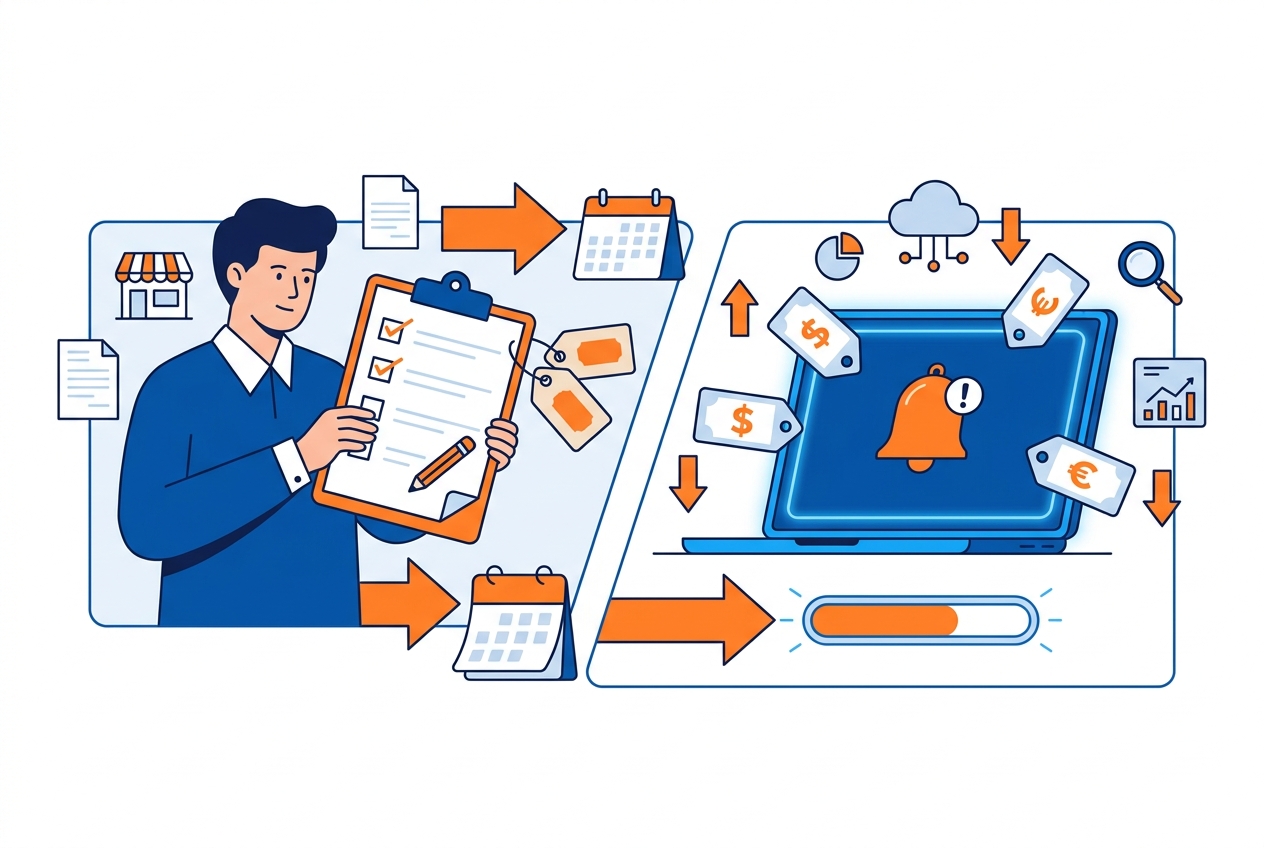
Manual monitoring means checking competitors’ sites yourself, subscribing to their newsletters, following their social accounts, and setting up Google Alerts for their brand. It’s free and fine for slow-moving signals like a monthly reputation scan or the occasional product launch. Its weakness is obvious: it doesn’t scale, and it goes stale within a day for anything that moves fast.
Automated monitoring uses software to track competitors continuously and alert you when something changes. This is essential for the fast-moving, high-value signals — above all, price and stock. A tool checks thousands of competitor products on a schedule you’d never manage by hand, and tells you the moment a key item moves. For anything you’d want to react to the same day, automation isn’t a luxury; it’s the only way to keep the picture current.
Why price is the signal to automate first
If you only automate one dimension, make it price. It’s the most direct lever on your sales and margin, it changes the most often, and it’s the signal customers act on fastest. Manually tracking competitor prices across a real catalogue is a losing game — the data is stale before you’ve finished the spreadsheet.
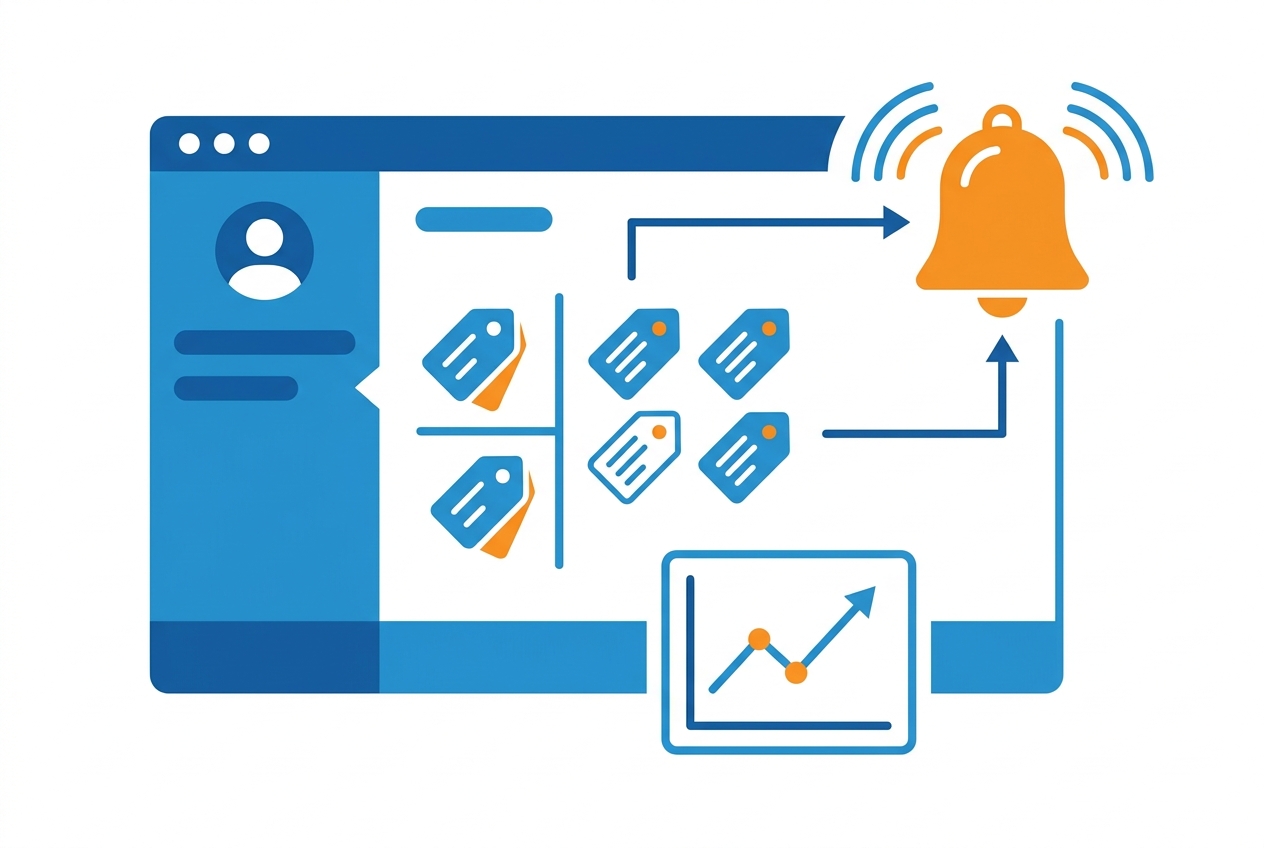
This is exactly what dedicated competitor price monitoring software is built for: it tracks your rivals’ prices and stock across sites and marketplaces automatically, matches them to your products, and alerts you when a key competitor moves. Feed that live data into price intelligence and you can see exactly where you sit in the market at any moment. Take it one step further with dynamic pricing, and your catalogue can respond to those competitor moves automatically, within the margins you set — turning monitoring from a report you read into a system that acts.
Frequently asked questions
What is competitor monitoring?
Competitor monitoring is the ongoing practice of tracking competitors’ prices, products, promotions, marketing, and reputation, then using those insights to inform your own strategy. It’s also known as competitive intelligence.
Why is monitoring competitors important?
It lets you price deliberately, respond to rivals’ moves quickly, spot market gaps and new threats, and plan strategy based on evidence rather than assumptions — all of which protect and grow your share.
What should you monitor about competitors?
Focus on the six highest-signal dimensions: pricing, stock and availability, promotions, product range, marketing/SEO, and reviews/reputation — with pricing and stock watched most frequently.
How do you monitor competitor prices?
Manually you’d check each competitor’s site regularly, but that doesn’t scale. Most ecommerce businesses use automated competitor price monitoring software that tracks rivals’ prices across sites continuously and alerts you when a key product changes.
How many competitors should I monitor?
A focused set you actually watch beats a long list you ignore — typically a handful of direct competitors plus a few indirect ones, scaled to your budget and category.
However broad your view of the competition, the dimension that moves your revenue fastest is price. When you’re ready to stop tracking it by hand, price monitoring software keeps every competitor’s price in front of you in real time.