Andrea Cramer
A pricing strategy is the method you use to decide what to charge for a product — the logic that turns cost, competition, and customer value into a number on the page. Get it right and it quietly compounds every sale; get it wrong and no amount of marketing rescues the margin. After fifteen years setting prices for brands and ecommerce catalogs, I’ve learned that the stores that win rarely have one clever price. They have a deliberate strategy, and they know exactly which one they’re using and why.
This guide walks through the three foundations every price rests on, the 10 pricing strategies worth knowing (with examples), how psychological pricing works, and a simple framework for choosing the right one for your store.
What you’ll find in this guide
- What is a pricing strategy?
- The three foundations every price rests on
- 10 pricing strategies for ecommerce (with examples)
- Psychological pricing: the mind games that move margin
- How to choose the right pricing strategy
- How to test and monitor your prices
- Frequently asked questions
What is a pricing strategy?
A pricing strategy is the approach a business uses to set the price of its products or services. It weighs three forces — what the product costs you, what competitors charge, and what customers are willing to pay — and resolves them into a price that hits your goals for profit, volume, and positioning.
It helps to separate strategy from tactic. Charm pricing ($9.99 instead of $10) is a tactic. Deciding you compete as the premium option in your category, and pricing every product to protect that position, is a strategy. Tactics live inside strategies. This guide is mostly about the strategies, with the tactics that support them.
The three foundations every price rests on
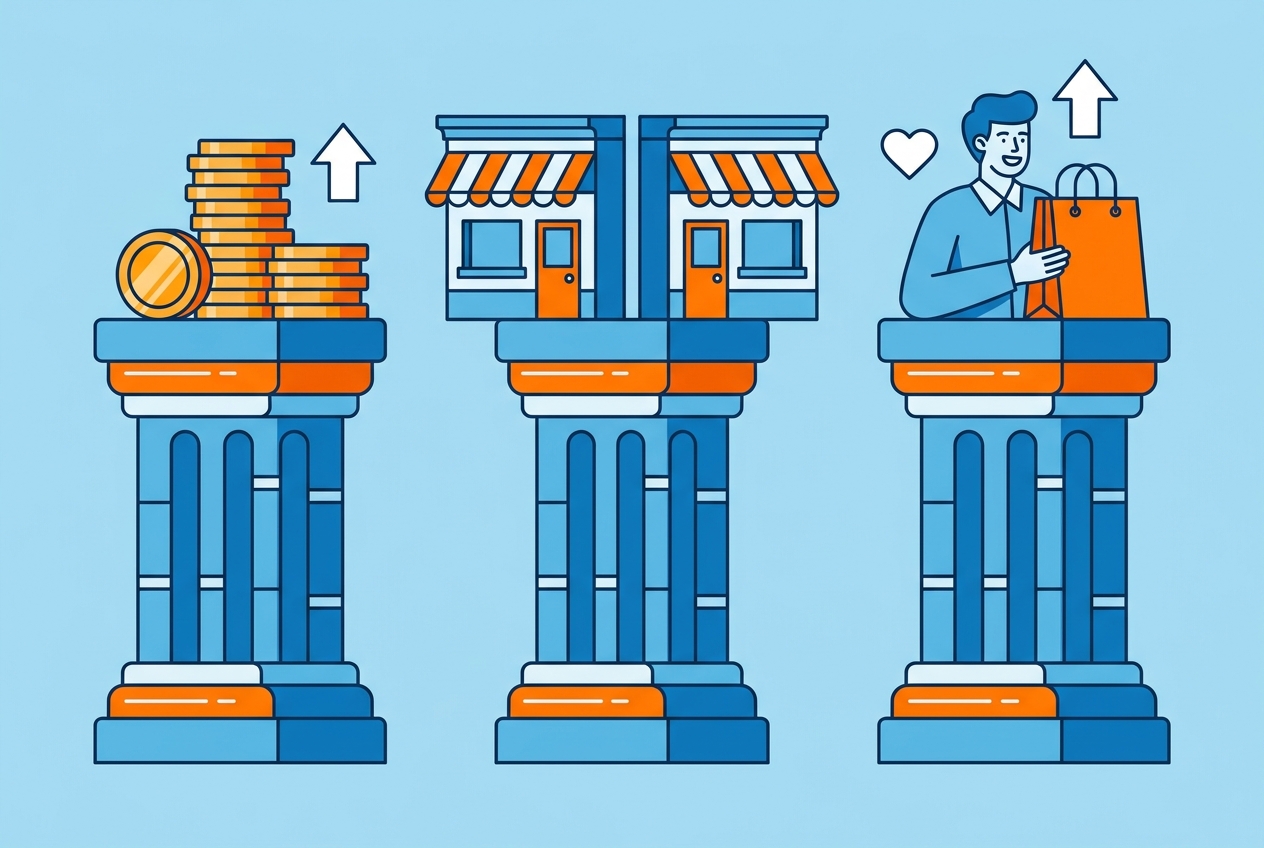
Almost every pricing strategy is a variation on one of three foundations. Learn these and the rest are combinations.
1. Cost-plus pricing. Add up what the product costs you and add a fixed margin. If a kitchen blender costs $50 to make and pack and you apply a 30% markup, you sell at $65. It’s simple and guarantees you cover cost — but it ignores what customers would happily have paid, so it quietly caps your upside.
2. Competitive pricing. Set your price by reference to comparable products in the market. If rivals sell a similar blender between $60 and $70, pricing at $65 puts you in the band — neither the cheapest nor the dearest. The catch: it’s only as good as your view of the market, so it depends on knowing competitors’ current prices, not last quarter’s.
3. Value-based pricing. Set the price by the value the customer perceives, not by your cost. If your blender has a touchscreen no competitor offers, and buyers genuinely value it, $80 can outsell $65 — because the price reflects the benefit, not the bill of materials. It’s the most profitable foundation and the hardest to execute, because it demands you actually understand your customer.
Most healthy catalogs blend all three: a cost floor you never breach, a competitive band you stay aware of, and value-based room on the products where you’ve earned it.
10 pricing strategies for ecommerce (with examples)
Here are the ten strategies I reach for most, what each one does, and where it fits.
Two close relatives deserve their own reading because they’re easy to get wrong: loss-leader pricing (selling one item at a loss to pull in profitable baskets) and predatory pricing (pricing below cost to squeeze out rivals — which carries real legal risk). Both are volume plays with sharp edges.
Psychological pricing: the mind games that move margin
Psychological pricing works because customers don’t read prices rationally — they read them fast. A few well-documented effects do most of the work.

Charm pricing. $99.95 reads as meaningfully cheaper than $100, even though it isn’t, because we anchor on the left-most digit. For impulse and price-sensitive products, that fractional gap can lift conversions.
Removing friction cues. In a well-known study at the Culinary Institute of America, diners were shown menus with prices written three ways — with a dollar sign, without, and with the word “dollars” spelled out. Guests spent noticeably more when the dollar sign was absent, because the symbol itself reminds people they’re spending money. Many premium ecommerce brands drop currency clutter for the same reason.
Anchoring. Show a higher-priced option first and the next option down looks like a deal. A “$199 / $99 / $49” ladder sells more $99 units than $99 alone ever would.
One caution from experience: psychological pricing is seasoning, not the meal. Lean on discounts and charm prices too hard and you train customers to distrust your regular price — and you cheapen a premium brand. For more on how a single price shapes perception, see our guide to what a price point is.
How to choose the right pricing strategy
There’s no universally best strategy — only the right one for your product, market, and goals. I work through four questions, in order:
1. What’s your goal right now? Winning market share points to penetration or economy pricing. Maximizing margin on a strong product points to value-based or premium. Be honest about which one you’re actually optimizing for; you can’t have both at once.
2. How differentiated is the product? A genuine, visible edge earns value-based or premium pricing. A near-commodity forces you toward competitive or economy — the market sets the ceiling, not you.
3. What does your cost structure allow? Thin margins can’t survive an economy or loss-leader play; a lean operation can. Your floor decides which strategies are even available.
4. How fast does your market move? Stable categories can live on a fixed strategy. Fast-moving, competitive catalogs increasingly need dynamic pricing to keep each price in its optimal band without manual work.
How to test and monitor your prices
A pricing strategy isn’t “set and forget” — it’s a hypothesis you keep checking against reality. Three habits keep it honest.
Test before you commit. Run candidate prices against a control and watch conversion and margin together — a price that lifts conversion but guts margin isn’t a win. A/B price testing is the cleanest read on real behavior.
Watch the competitive band continuously. Competitive and dynamic strategies both depend on knowing what rivals charge right now. Manual checks go stale within a day, so most teams monitor competitor prices automatically and get alerted when a key SKU moves.
Turn the data into decisions. The point of tracking isn’t a spreadsheet — it’s timely, confident price moves. Feeding your strategy with live market data, the domain of price intelligence, is what separates a real strategy from a guess that hardened into a habit.
Frequently asked questions
What is a pricing strategy?
A pricing strategy is the method a business uses to set prices, balancing production cost, competitor pricing, and customers’ perceived value to hit its goals for profit, sales volume, and market positioning.
What are the main types of pricing strategies?
The most common are cost-plus, competitive, value-based, penetration, price skimming, psychological (charm) pricing, dynamic pricing, premium/prestige, economy, and bundle pricing. Most stores combine several across their catalog.
What is the best pricing strategy for ecommerce?
There’s no single best strategy. Differentiated products with a real edge do best with value-based or premium pricing; commodity-like products in crowded markets usually need competitive or dynamic pricing. The right choice depends on your goal, differentiation, cost structure, and how fast your market moves.
What is the difference between cost-plus and value-based pricing?
Cost-plus pricing sets the price by adding a fixed margin to your cost. Value-based pricing sets it by what the customer perceives the product is worth. Cost-plus is simpler but caps your upside; value-based is more profitable but requires you to understand your customer.
How often should I review my pricing strategy?
Continuously for fast-moving or competitive catalogs — ideally with automated monitoring — and at minimum each quarter for stable ones. Prices and competitors shift constantly, so a strategy set once and never revisited drifts out of the money.
Whichever strategy you choose, the stores that hold the best prices are simply the ones that never stop watching the market. When you’re ready to automate that, price monitoring software keeps the competitive band in front of you in real time.