Paul Morello
MAP pricing (Minimum Advertised Price) is the lowest price a brand allows its resellers to advertise a product for. Not the lowest price they can sell it for — the lowest price they can show in an ad, a listing, or an email. That one-word distinction drives almost everything about how MAP works, why it’s legal in the US, and why enforcing it across hundreds of retailers is harder than writing the policy. I’ve sat on both sides of this — as a retailer getting the warning email, and on pricing teams sending them — so this guide covers the whole picture: what MAP means, how a MAP policy is built, the MSRP difference, legality, and what enforcement actually looks like.
What you’ll find in this guide
- What is MAP (Minimum Advertised Price)?
- How MAP pricing works
- MAP vs MSRP vs list price
- What is a MAP policy — and what goes into one
- Is MAP pricing legal?
- Why brands use MAP
- MAP from the retailer’s side
- How MAP is monitored and enforced
- Frequently asked questions
What is MAP (Minimum Advertised Price)?
MAP stands for Minimum Advertised Price: a floor that a manufacturer or brand sets for the price at which its products may be publicly advertised. A brand publishes a MAP policy, its authorized resellers agree to respect it, and from that point on no ad, product listing, comparison-engine feed, or promotional email may show a price below the floor.
The word advertised is the entire mechanism. MAP does not fix the final selling price — a retailer can still sell below MAP at checkout. That’s why you see workarounds like “add to cart to see price”: in many policies the cart price doesn’t count as public advertising, so the retailer discounts without technically violating the floor. Whether in-cart prices count as advertising is defined (or left dangerously vague) by each individual policy — it’s the first clause I check when reviewing one.
MAP is most common in categories where brand equity and dealer networks matter: consumer electronics, appliances, outdoor gear, tools, musical instruments. If you’ve ever wondered why a specific camera is advertised at exactly the same price at every retailer, MAP is usually the answer.
How MAP pricing works
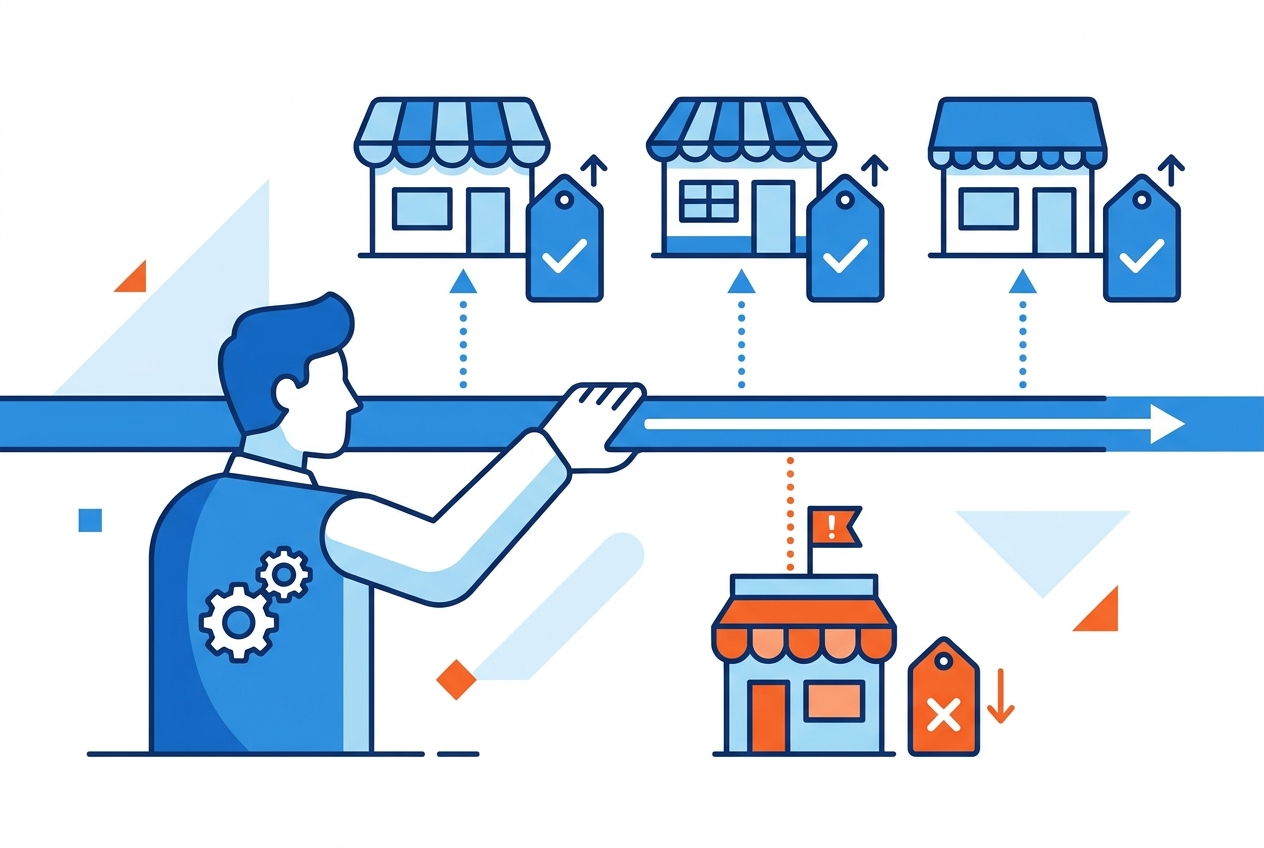
The mechanics follow a consistent pattern:
- The brand sets the floor. Per product or per line, usually as a fixed price (“no advertising below $199”) or a discount cap off MSRP.
- The policy is announced to resellers. In the US this is typically done unilaterally — the brand states its terms and reserves the right to stop supplying violators, rather than signing a price agreement (the legal reasons are below).
- Retailers price around it. Advertised prices sit at or above MAP; competition shifts to shipping, bundles, loyalty points, and cart-level discounts.
- The brand monitors and enforces. Someone — a person or, realistically, software — checks advertised prices across retailers, marketplaces, and shopping feeds, flags violations, and escalates: notice, then supply suspension, then termination as an authorized dealer.
Where it gets messy is scale. A mid-size brand with 200 SKUs across 50 retailers and three marketplaces has tens of thousands of advertised prices moving daily. Violations rarely start as defiance — they start as a forgotten promo, a stale feed, or a marketplace repricer chasing a competitor below the floor. By the time a human notices, the whole shelf has followed. That’s why serious MAP programs run continuous price monitoring rather than spot checks.
MAP vs MSRP vs list price

The three get mixed up constantly, and the difference is binding force:
In practice the three work together: a $249 MSRP product might carry a $219 MAP, letting retailers advertise a visible discount without racing to the bottom. MSRP and its cousins are a topic of their own — our guide to RRP (recommended retail price) covers how suggested prices are set and used.
What is a MAP policy — and what goes into one
A MAP policy is the document that makes the floor real: it defines which products are covered, what counts as advertising, and what happens to violators. Weak policies share a pattern — vague scope, no violation tiers, inconsistent enforcement. A policy that actually holds contains six things:

That last row is doing legal work, not formality — it’s what separates a defensible US MAP policy from an antitrust problem, as the next section explains.
Is MAP pricing legal?
In the United States — yes, when structured properly. The safe pattern is the unilateral policy: the brand independently announces its advertising terms and reserves the right to stop dealing with violators. That approach rests on the Colgate doctrine (United States v. Colgate & Co., 1919): a supplier may unilaterally announce its terms and refuse to deal with those who don’t follow them. It’s why well-drafted MAP programs avoid signed pricing agreements with retailers — the moment it becomes a mutual agreement on prices, it drifts toward resale price maintenance, which federal courts judge case-by-case under the rule of reason since Leegin (2007) — and which some states, California among them, still treat as per se illegal under their own antitrust laws. The distinction between announcing terms and agreeing on prices is exactly what a unilateral pricing policy (UPP) formalizes.
In the EU — effectively no. The EU’s 2022 Vertical Guidelines explicitly treat MAP as an indirect form of resale price maintenance — a hardcore restriction. Efficiency defenses exist on paper, but you don’t build a distribution strategy on them. Brands selling into Europe use recommended prices (RRP) and selective distribution instead of MAP. If you run a US MAP program and expand to the EU, don’t copy the playbook across — it needs a different legal instrument.
The practical takeaway for operators: never sign a document that fixes advertised prices bilaterally, never email a retailer “agreeing” on a price, and have counsel review the policy. This section is orientation, not legal advice.
Why brands use MAP
Three reasons come up in every MAP conversation I’ve been part of:
- Margin protection down the channel. If advertised prices spiral, retailer margin evaporates, and retailers respond rationally: they stop stocking, stop promoting, or demand rebates. The floor keeps the product profitable to carry.
- Brand equity. A product that’s perpetually advertised at −40% reads as a discount brand within a couple of quarters. The advertised price is brand positioning.
- A level playing field. Small dealers can’t win a race to the bottom against volume discounters. MAP keeps the long tail of retailers — often the ones doing demos, service, and category advocacy — economically alive.
The honest downsides: consumers pay more than they would in unrestricted competition; enforcement costs real money and attention; and a MAP program applied inconsistently is worse than none, because compliant retailers watch violators keep selling and conclude the policy is theater.
MAP from the retailer’s side
If you’re the reseller, MAP changes where you’re allowed to compete. You can’t win the ad price, so you win everything around it: bundle value, shipping speed, loyalty programs, cart-level discounts where the policy permits them, and availability when violators get cut off. A few field rules:
- Know each policy’s definition of advertising. Cart prices, coupon codes, and email-exclusive offers are permitted under some policies and violations under others. Don’t assume — read.
- Watch your automation. The most common accidental violation is a repricer or a stale promo pushing a public price below the floor. If you automate pricing, set MAP as a hard floor per SKU in your repricing rules so the software physically can’t cross it.
- Violations follow a script. First a notice with a cure window, then held orders or suspended supply, then termination. Brands track repeat offenders; “we fixed it after the email” works once.
How MAP is monitored and enforced
A policy without monitoring is a suggestion. Enforcement runs on three loops: detect (track advertised prices for every covered SKU across retailer sites, marketplaces, and shopping feeds), document (timestamped evidence of each violation — screenshots, URLs, price history), and escalate (apply the violation tiers consistently, including to your biggest account, or the policy dies). Marketplaces add a twist: unauthorized third-party sellers aren’t bound by your policy at all, so the fight there is seller identification and distribution control, not MAP letters.
Doing this manually across thousands of SKU-retailer pairs isn’t realistic, which is why brands run dedicated MAP monitoring software that watches every advertised price and flags violations with evidence attached. We’ve written a full operational guide to MAP monitoring — how to set up detection, what to document, and how the escalation ladder works in practice.
Frequently asked questions
What does MAP stand for in retail?
Minimum Advertised Price — the lowest price a reseller is allowed to advertise a product for under the brand’s policy. It restricts the advertised price, not the final selling price.
What is MAP pricing?
MAP pricing is the practice of setting and enforcing that advertised-price floor. The brand publishes a MAP policy, monitors advertised prices across its retailers, and applies consequences — from warnings to cutting supply — to violators.
What is the difference between MAP and MSRP?
MSRP is a suggestion for the selling price with no consequences attached. MAP is an enforced floor for the advertised price. A product often has both: MSRP anchors the “full price,” MAP defines how deep any advertised discount can go.
Can retailers sell below MAP?
Usually yes — MAP governs advertising, not the checkout. That’s why some retailers show “add to cart to see price.” Whether cart prices, coupons, or email offers count as advertising depends on each policy’s wording.
Is MAP pricing legal?
In the US, properly structured unilateral MAP policies are generally lawful. In the EU, advertised-price floors are treated like resale price maintenance and are effectively prohibited — brands use recommended prices instead.